Category: Technology

  • More Farmer Than Monk

    More Farmer Than Monk

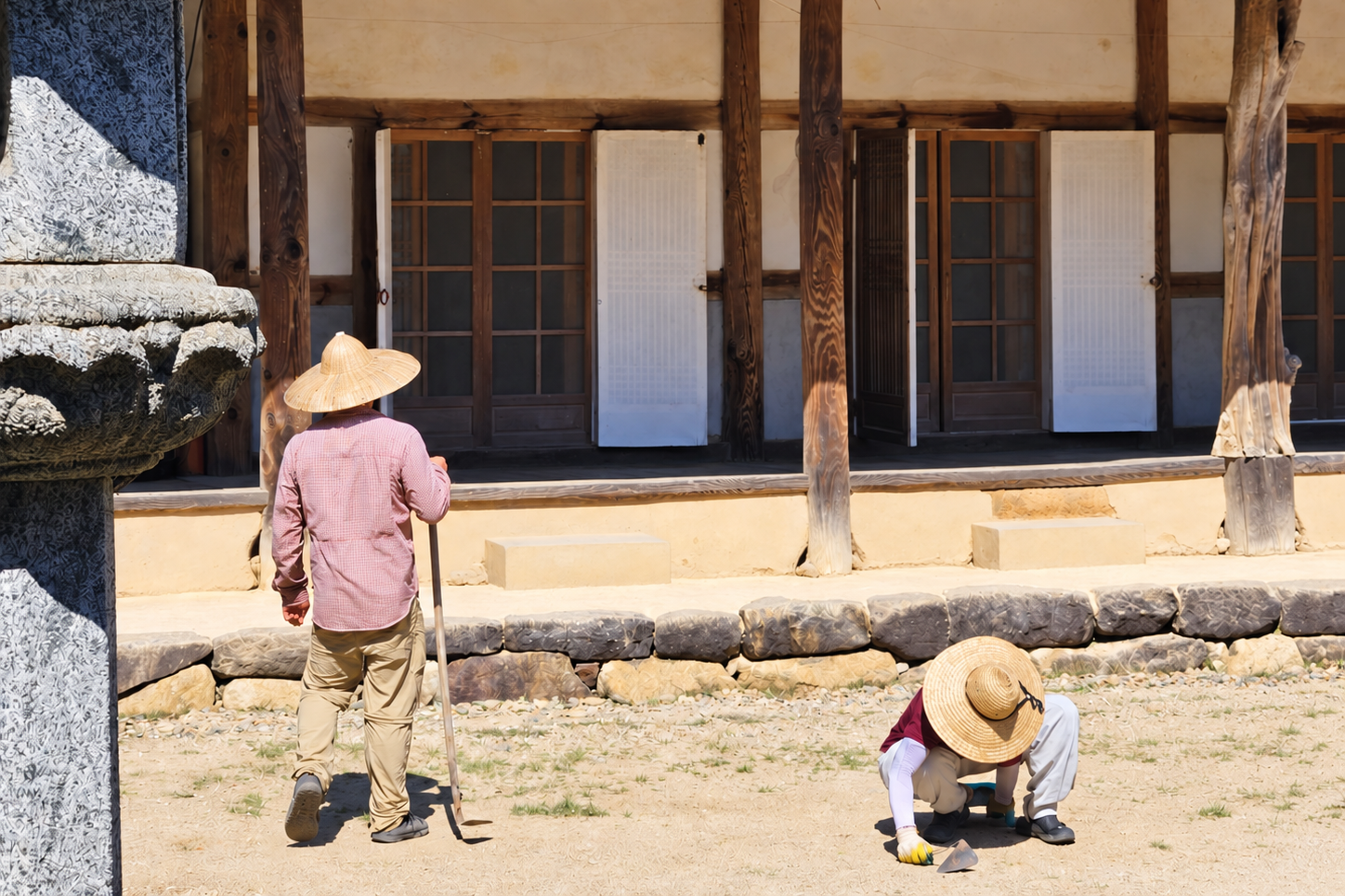
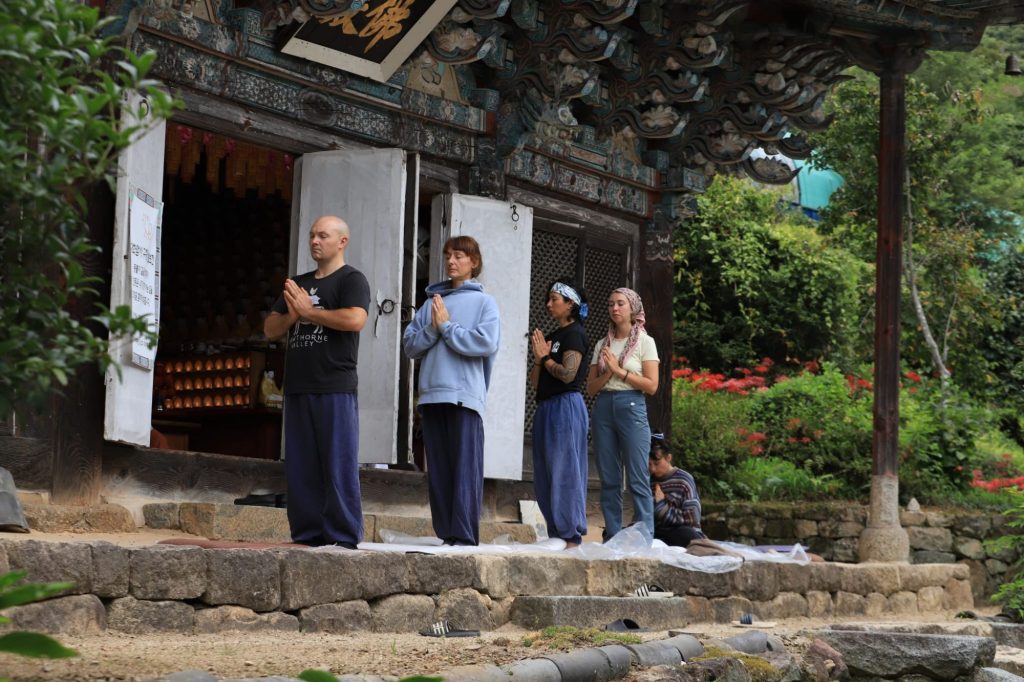
    I spent about a month at Gucheungam Hermitage, a small Buddhist hermitage above Hwaeomsa Temple on the slopes of Jirisan in South Korea.


    Before arriving, I had shaved my beard. Between the shaved head, simple clothes, and the fact that I was living at a Buddhist hermitage, I kept getting mistaken for a monk.


    After a month there, though, one thing became increasingly clear: I am definitely more farmer than monk.

    A Different Pace

    Much of the weeding around the hermitage was done slowly and meticulously. People sat on little stools or crouched close to the ground with short-handled hoes, working through an area one weed at a time. There was something almost appropriately monastic about it: careful, patient, attentive.


    I could appreciate the approach. If anywhere in the world weeding were to be done this way, would not a buddhist hermitage high in the mountains of Asia be the place?


    But after spending most of my adult life growing vegetables, I also couldn’t stop looking at all that ground and thinking about how much other work needed to be done too.


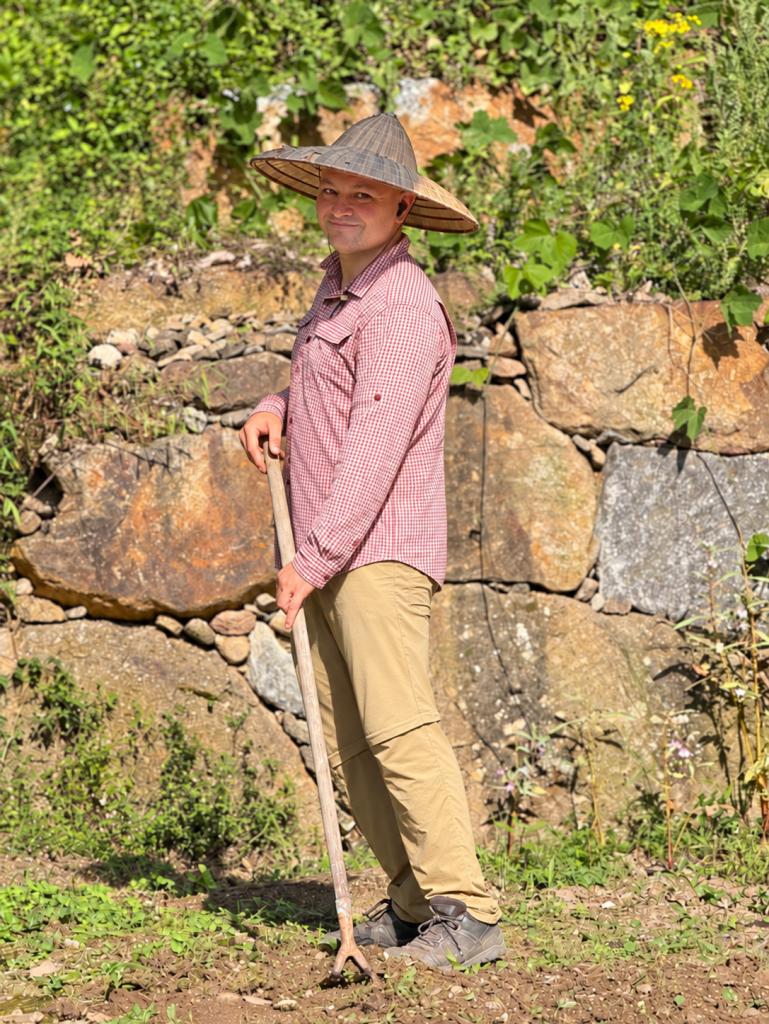
    Eventually, I found an old long-handled hoe somewhere around the hermitage. It didn’t look like it had been used much.
    I sharpened the edge and started working.

    80% Results with 20% of the Effort


    The difference was immediate. Instead of sitting down and removing weeds individually, I could stand upright and sweep the sharpened blade just beneath the surface of the soil.

    • One stroke killed several weeds
    • A few strokes cleared an entire area
    • I could use a rake to gather the larger weeds, and move on


    The result wasn’t perfect – if someone followed behind me with a hand hoe, they could certainly find weeds I had missed. But that wasn’t really the point.


    My rough way of thinking about it was:
    I could kill 80 percent of the weeds in 20 percent of the time – on a production farm, that’s often a very good trade.
    If you have limited labor and a large area to cover, getting five areas mostly clean can be much more useful than getting one area perfectly clean while the other four disappear under weeds.

    Too Much Credit


    People started noticing how quickly I was moving.
    Then they wanted to try it. More long-handled hoes started appearing from wherever old tools were stored around the hermitage, and other people began working the same way. At one point I overheard someone refer to it as the “Tyler method.”
    That made me laugh.


    I would like the historical record to be clear that I did not invent hoeing. Farmers have been standing upright and killing weeds with hoes for quite a while. If anything, the funny part was that the tool and the technique were already there. All I really contributed was finding an old hoe, sharpening it, and using it for the sort of work it was designed to do.

    Precision vs Speed


    The experience highlighted a distinction I think matters well beyond weeding – hand hoes aren’t bad tools.
    In tight spaces, around valuable plants, against stones, or anywhere that demanded precision, they were probably better than what I was doing.


    The long-handled hoe optimized for something different:
    Speed. That changes the question from: Which tool does the best job? to: What result am I trying to achieve?


    If the goal is immaculate ground, meticulous hand weeding makes sense. If the goal is preventing thousands of weeds from reaching maturity while you have a limited number of people and hours, speed becomes much more important.


    Neither approach is inherently right. They solve different problems.

    The Tool Changes the Job


    What interested me most wasn’t that the hoe was faster. That part is obvious. It was how dramatically changing one simple tool changed the scale at which I could think about the work.


    Sitting on a stool, I was looking at the weeds directly in front of me – standing with a long-handled hoe, I was looking at the whole area. The tool changed my posture, my speed, the amount of ground I could cover, and ultimately the standard of “finished” work that made sense.

    • No engine
    • No chemicals
    • No subscriptions
    • No Wifi or bluetooth

    Just a sharpened piece of steel attached to a slightly longer stick.

    Some of the most valuable improvements I’ve seen in agriculture are like that. They aren’t revolutionary inventions. They’re small changes in tools or workflow that make repeated work substantially easier.
    More Farmer Than Monk


    I learned a lot during my month at Gucheungam, much of it from people whose pace and priorities were very different from what I’m accustomed to on a production farm.

    • There’s value in slowing down
    • There’s value in doing things carefully
    • There’s value in work that isn’t measured in output per hour


    But apparently, even after shaving my beard and spending a month getting mistaken for a monk, you can put me in front of a weedy patch of ground and my farmer brain is still going to start calculating how quickly we can get through it.


    I came to Korea partly because I wanted to learn how other people live and work. At Gucheungam I was reminded that exchange goes both ways.

    • Sometimes you bring home a new technique
    • Sometimes you leave one behind
    • Sometimes you accidentally get your name attached to a farming practice that probably several thousand years old.
  • Small Farms Should Use Less Software

    Small Farms Should Use Less Software

    I have a computer science degree, spent several years writing software, and have spent more than a decade working on small organic vegetable farms.

    Those two experiences have left me with a slightly inconvenient opinion:

    • Small farms often need less software, not more.

    That probably sounds strange coming from someone who also helps farms and agricultural organizations with websites, technology, spreadsheets, and digital systems. But the longer I’ve worked in both farming and technology, the more convinced I’ve become that software is rarely the first thing that needs fixing.

    Usually, the system underneath it does.

    A New Tool Won’t Fix an Unclear Process

    Small farms are complicated operations.

    There are crops to plan, seeds to order, employees to coordinate, harvest records to keep, labels to print, customers to communicate with, grants to manage, equipment to maintain, events to organize, and bills to pay.

    When one of those processes becomes messy, it’s tempting to look for an app.

    There probably is one.

    There are farm-management platforms, project-management systems, CRMs, inventory tools, scheduling apps, bookkeeping integrations, form builders, marketing platforms, and software specifically designed for almost every agricultural task imaginable.

    But buying software before understanding the actual problem often just creates a more complicated version of the same problem.

    If three people record information differently, putting that information into an app doesn’t automatically make it consistent.

    If nobody knows who is responsible for updating a crop plan, moving the crop plan into a prettier interface doesn’t solve that.

    If the real problem is that a task has seven unnecessary steps, digitizing all seven steps isn’t much of an improvement.

    Sometimes the most valuable technology decision is deciding not to add another piece of technology.

    Software Has an Ongoing Cost

    The price of software matters more on a small farm than it does in a large organization.

    Ten dollars a month doesn’t sound like much. Neither does twenty or thirty.

    But subscriptions accumulate.

    A website platform, bookkeeping system, email service, farm-management application, scheduling tool, cloud storage account, point-of-sale system, and a few specialized services can quietly become hundreds or thousands of dollars per year.

    And subscription pricing rarely stays fixed forever.

    That doesn’t mean paid software is a bad investment. A tool that saves several hours of labor every month can easily pay for itself.

    But the question should be whether the tool is actually creating enough value to justify becoming another permanent operating expense.

    I’m especially cautious about paying for sophisticated software to solve a problem that could be handled almost as well by a spreadsheet or another tool the organization already pays for.

    I Like Spreadsheets More Than I Probably Should

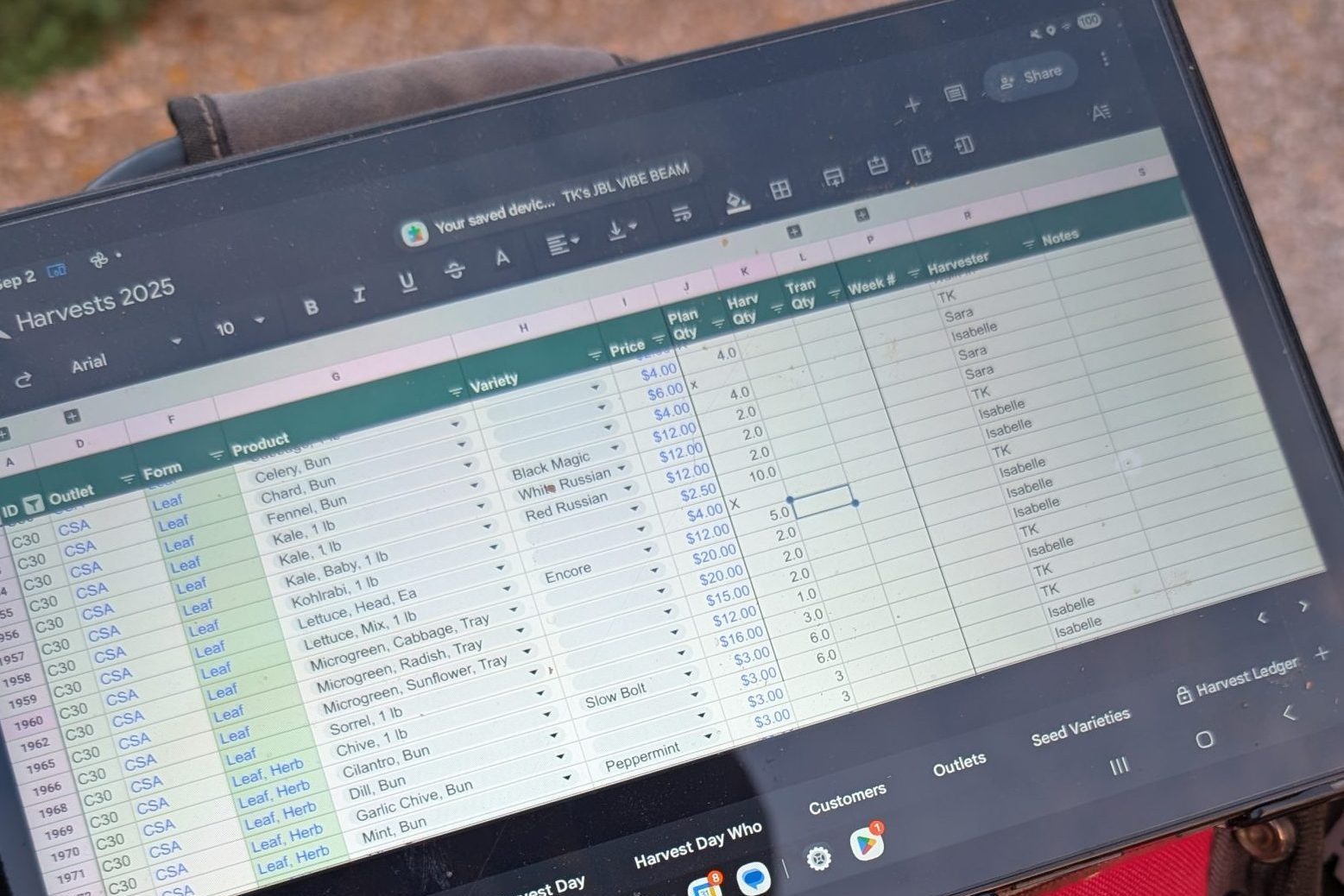
    I’ve built software professionally, but a surprising amount of useful work on farms can be handled with a spreadsheet.

    That isn’t because spreadsheets are sophisticated. It’s because they’re flexible, understandable, and easy to change.

    A spreadsheet can become a crop plan, harvest record, contact list, event roster, planting schedule, grant budget, seed inventory, or label database without requiring someone to learn an entirely new system.

    More importantly, people will actually use them.

    That last part matters.

    The technically best system is not always the practically best system.

    A custom database may be capable of doing everything a farm needs, but if only one person understands it, the system becomes dependent on that person.

    A specialized farm-management platform may have dozens of useful features, but if employees avoid entering information because the interface is cumbersome, the data isn’t useful.

    Meanwhile, a boring Google Sheet that everyone understands may quietly run an operation for years.

    That doesn’t mean spreadsheets are always the answer. It means complexity has a cost, and small organizations should have a good reason for taking it on.

    Who Actually Owns Your Data?

    There’s another question I think small organizations should ask before adopting software:

    If I stop using this service tomorrow, what happens to my information?

    Your crop records, customer lists, financial history, planting plans, donor information, event registrations, and production data may represent years of work.

    Ideally, you should be able to export that information in a useful format and move it somewhere else.

    That isn’t always the case.

    Some platforms make exporting easy. Others let you export only part of your data, give it back in an awkward proprietary format, or make leaving sufficiently difficult that switching services becomes a major project.

    The more important the information is to your operation, the more I care about portability.

    Before committing to a platform, I want to know:

    • Can the data be exported?
    • What format does it come in?
    • Can another program actually read it?
    • Will the farm still have access to historical records if it cancels the subscription?
    • How difficult would it be to migrate to something else?

    A system can work perfectly today and still become a liability if your entire operation is trapped inside it five years from now.

    The Boring Systems Often Matter Most

    Some of the most useful systems I’ve worked on have not been impressive.

    Label printing is a good example.

    Printing product or seedling labels doesn’t sound like an important technology project. But if someone has to repeatedly type the same information, manually format labels, correct mistakes, and search for old files every time something needs printing, that small inefficiency gets repeated hundreds or thousands of times.

    Organizing the underlying information and creating a repeatable printing process can save far more time than introducing an elaborate new platform.

    The same is true for forms.

    A well-designed Google Form feeding into a clean spreadsheet can solve a registration, intake, volunteer, or recordkeeping problem with almost no training.

    Everyone already understands how to click a link and fill out a form.

    That simplicity has value.

    Start With the Workflow

    When someone asks me what software they should use, I increasingly want to ask questions first.

    • What are you actually trying to accomplish?
    • Who needs to use the system?
    • What happens before the information gets there?
    • What happens afterward?
    • Where does the current process fail?
    • Which parts are repetitive?
    • Who maintains it?
    • What happens when that person is gone?

    Those questions often reveal that the technology itself isn’t the central problem.

    Imagine a farm struggling to keep track of harvest quantities.

    The first instinct might be to find harvest-tracking software.

    But the real questions are more basic.

    • Who records the harvest?
    • When?
    • By crop, variety, field, or destination?
    • Does someone need that information the same day?
    • Is it being used for crop planning next year, inventory management this afternoon, or simply because someone thinks harvest records are a good idea?

    Until those questions are answered, choosing software is mostly guessing.

    Once they are answered, the solution might be specialized software.

    It might also be a clipboard and a spreadsheet.

    Sometimes Software Really Is the Answer

    I’m not arguing that farms should avoid technology.

    There are plenty of situations where dedicated software earns its complexity.

    A website is obviously better handled by a content management system than by manually editing HTML every week.

    Online payment platforms make accepting donations or payments dramatically easier.

    Email marketing software is useful when an organization has hundreds or thousands of contacts.

    Accounting software exists for good reasons.

    And when a farm grows large enough, crop planning, inventory, employee management, or sales can become complicated enough that purpose-built tools are worth learning.

    The question isn’t whether software is good.

    The question is:

    • Does this tool remove more complexity than it creates?

    For a small farm, I’d add two more questions:

    • Is the value worth the ongoing cost?
    • And can I take my data with me if I leave?

    Technology Should Disappear Into the Work

    The best systems rarely feel impressive once they’re working.

    • Someone fills out a form.
    • A spreadsheet updates.
    • A label prints correctly.
    • A customer gets the information they need.
    • An employee knows what to do next.

    Nobody thinks much about the technology because they’re busy doing the actual work.

    I think that’s a good outcome.

    Farmers already have plenty of things demanding their attention. Technology should reduce that burden rather than becoming another thing that needs to be managed.

    My own rule is becoming increasingly simple:

    • Use the simplest system that reliably solves the problem.
    • Sometimes that means custom code.
    • Sometimes it means WordPress.
    • Sometimes it means specialized farm software.
    • Sometimes it means a spreadsheet.
    • And sometimes it means putting the computer away entirely.

    The goal isn’t to make a farm more technological.

    The goal is to make it work better.